
Artificial intelligence is no longer an experiment in search. It is the interface. What began as AI-driven relevance and recommendation has evolved into systems capable of generating text, images, video, and even code. Today, Google AI ads sit at the center of how users search, evaluate information, and take action.
As Google Ads AI capabilities continue to expand, advertisers are now seeing Google AI overview ads and ads in AI Overviews appear directly within AI-generated search experiences. This shift represents some of the most important Google AI ads news in years, fundamentally changing how visibility is earned across search.
For advertisers, the question isn’t whether AI ads or Google AI ads will appear, it’s how to position campaigns to perform within AI-powered environments like AI Overviews and Google Ads in AI Mode.
Key Takeaways
- Google AI ads are now appearing directly within and around AI-generated search results, including Google AI Overviews and Google Ads in AI Mode. This marks a major shift in how paid visibility is earned.
- Ads in AI Overviews are not a new format, but a new placement for existing campaign types like Performance Max, Shopping campaigns, broad-match Search, Dynamic Search Ads, and AI Max Google Ads.
- AI-powered search is accelerating a “zero-click” trend, where users often get answers faster, meaning advertisers must align ads with informational intent earlier in the decision journey.
- Shopping and Performance Max campaigns currently have the strongest visibility inside AI Overviews, while standard Search campaigns most often appear above or below the AI-generated content.
- AI Mode expands ad matching beyond single queries, using conversational context and evolving intent to determine when Google AI mode ads are shown.
- Creative quality and data signals matter more than ever, including strong conversion tracking, clean campaign structure, high-quality landing pages, and rich assets like images and AI video ads.
- The same AI-driven principles extend beyond Google, influencing Meta (Facebook), Microsoft (Bing), and LinkedIn ad placements.
What Are Google AI Overviews and Where Do Google AI Overview Ads Fit In?
Google AI Overviews are AI-generated summaries that appear directly in search results when Google determines a generative response would be especially helpful. These overviews synthesize information from multiple sources to help users quickly understand a topic, explore options, or decide on next steps.
You may encounter AI Overviews not only through traditional text searches, but also when:
- Searching with an image
- Using Circle to Search on supported devices
- Engaging with Google’s emerging AI Mode experiences
Ads can appear:
- Above or below AI Overviews (globally, where AI Overviews are available)
- Within the AI Overview itself (currently available in select countries, including the U.S.)
These are not new ad formats. Instead, they are new placements for existing Search, Shopping, Performance Max, and other AI-powered campaigns, clearly labeled as Sponsored and contextually integrated into the AI-generated experience.
Related Reading: What is Generative Engine Optimization(GEO) and Why it Matters in 2026
How Ads Work in Google AI Mode
In addition to AI Overviews, Google has introduced AI Mode, an expanded conversational search experience that allows users to explore complex topics over multiple interactions. Google AI Mode ads and Google Ads in AI Mode can appear when Google detects commercial relevance, using many of the same eligibility signals that power Google ads in AI overviews.
Rather than responding to a single query, AI Mode evaluates the full conversational context. As a result, Google AI ad placements are matched not just to keywords, but to evolving intent over time. Campaigns using AI-powered solutions, such as Performance Max, Shopping campaigns, broad-match Search, Dynamic Search Ads, and AI Max Google Ads, are best positioned to appear, as they give Google greater flexibility to align ads with nuanced user needs across longer discovery journeys.
A Shift Toward Faster Actions and Fewer Clicks
While ads in AI Overviews can shorten the path from discovery to decision, they are also part of a broader shift toward a more integrated, zero-click search experience.
Early data suggests:
- Ads within AI Overviews are often perceived as helpful, allowing users to move quickly from question to solution
- At the same time, AI Overviews can reduce click-through rates for traditional paid search results on certain queries
In other words, visibility is moving upstream in the decision journey. Ads that align with AI-generated context are being surfaced earlier — sometimes before users ever scroll to classic blue links.
Related Reading: Google Ads Trends and Technologies: What to Expect in 2026
How Ads Are Selected for AI Overviews
There is no special “AI Overview opt-in.” Ads appear automatically when several conditions are met.
1. Commercial Intent Is Detected
AI Overviews frequently trigger on complex or exploratory queries, even when the search isn’t overtly transactional. Google evaluates both the user query and the content of the AI Overview to determine whether commercial intent exists within the broader journey.

Example:
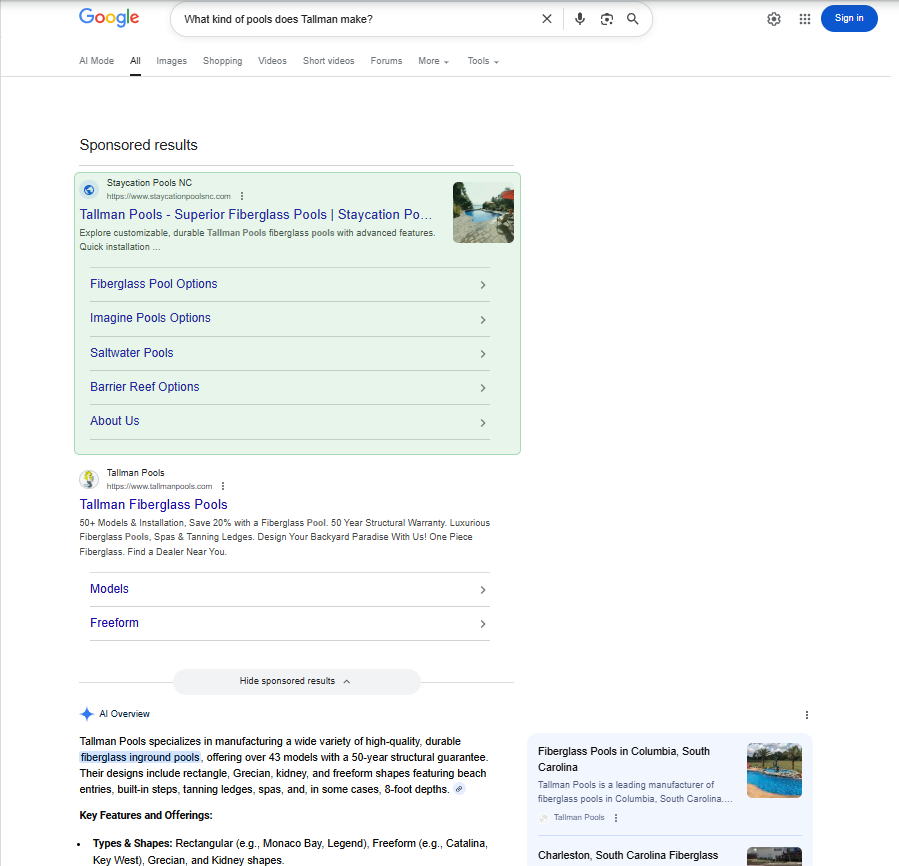
A homeowner in Surf City searches “What kind of pools does Tallman make?” while researching fiberglass pool options.
Google generates an AI Overview that begins with:
“Tallman Pools specializes in manufacturing a wide variety of high-quality, durable fiberglass inground pools, offering over 43 models with a 50-year structural guarantee. Their designs include rectangle, Grecian, kidney, and freeform shapes featuring beach entries, built-in steps, tanning ledges, spas, and, in some cases, 8-foot depths.”
The AI Overview continues by outlining Key Features and Offerings, including pool types and shapes, design flexibility, and special features available across Tallman’s fiberglass lineup.
Above the AI Overview, a sponsored result from Staycation Pools NC appears prominently. The ad headline reads:
“Tallman Pools – Superior Fiberglass Pools”
The ad includes:
- A featured image pulled dynamically from the campaign
- Sitelinks highlighting different Tallman pool options and designs
- Automatically generated copy from a Performance Max campaign, tailored to the user’s query and location
In this scenario, the advertiser benefits from top-of-page visibility above the AI-generated response, capturing attention at the exact moment a homeowner is researching a specific manufacturer. Even though the query is informational, Google detects strong commercial and local intent, allowing the ad to surface as a logical next step before the user engages with the AI Overview itself.
2. The Ad Wins the Existing Auction
Ads still serve through Google’s standard auction system, using familiar signals such as:
- Ad Rank
- Quality Score
- Bids and Smart Bidding strategies
3. Contextual Relevance Matters More Than Ever
To appear within an AI Overview, ads must be relevant not only to the user’s query, but also to the themes and information surfaced in the AI-generated response itself.
Currently:
- Text and Shopping ads from Search, Shopping, and Performance Max campaigns are eligible
- Sensitive verticals (finance, healthcare, politics, gambling, alcohol, etc.) are excluded
Personalization and Device Context Matter
AI Overviews are increasingly personalized, while still maintaining a shared informational core.
As of early 2026, personalization signals may include:
- Search history
- Location
- For opted-in users, select data from services like Gmail or Photos
Ads appear across both desktop and mobile, but device behavior differs meaningfully:
- Desktop currently dominates AI-powered referral traffic, with some reports suggesting over 90% of AI search referrals originate there
- Mobile AI Overviews appear more frequently for commerce-driven queries, with some studies showing up to 3× higher presence in e-commerce searches
Important context:
- Mobile AI experiences often use in-app previews, which can suppress direct site traffic
- Desktop users tend to engage more deeply with longer, AI-generated responses
Related Reading: PPC Campaigns That Convert: 7 Proven Tips to Maximize ROI
What Advertisers Can (and Can’t) Control
What you can’t do
- Target only AI Overview placements
- Opt out of AI Overview eligibility
- Access segmented reporting specifically for AI Overview impressions
What you can influence
- Account and campaign structure
- Conversion data quality
- Creative relevance and clarity
- Landing page alignment
Ads that appear in AI Overviews are currently reported as top ads in Google Ads, without separate breakout reporting.
Account & Campaign Structure Signals Matter
Ads don’t appear in AI Overviews because they’re “AI-optimized.” They appear because Google already trusts them.
Key trust signals include:
- Conversion clarity and data quality
- Clean campaign segmentation
- Strong historical performance
These signals help Google confidently surface ads within high-trust, AI-generated experiences.
| Feature | Search Campaigns | Shopping Campaigns | Performance Max |
| Eligible for AI Overviews | Yes | Yes | Yes |
| Most common placement | Above or below AI Overview | Inside and around AI Overview | Inside, above, below, and across surfaces |
| Likelihood of appearing inside AI Overview | Low | High | Very High |
| Targeting model | Keywords (broad) | Product feed–based | Keywordless / intent-driven |
| Alignment with AI contextual matching | Moderate | Strong | Very Strong |
| Creative & asset flexibility | Limited (text-focused) | Medium (images, pricing, product data) | High (text, images, video, audiences) |
| Best for commerce-driven queries | Moderate | Excellent | Excellent |
| Role in AI Mode experiences | Limited | Strong | Primary |
| Reporting visibility | Standard (no AI Overview breakout) | Standard (no AI Overview breakout) | Standard (no AI Overview breakout) |
How to Improve Your Chances of Appearing in AI Overviews
1) Align Paid Search With Informational Intent
Don’t isolate paid search from content strategy. Ads that educate, guide, and explain perform better in AI-driven environments.
2) Optimize Landing Pages for AI Consumption
- Clear headings and FAQs
- Concise explanations
- Visible expertise and trust signals
Avoid bloated, purely promotional copy.
3) Feed AI Better Signals With Strong Conversion Data
- Proper GA4 and GTM setup
- Enhanced conversions
- Goals that reflect real business outcomes
4) Leverage AI-Powered Campaign Types Strategically
Google has confirmed that Performance Max, Shopping campaigns, broad-match Search, Dynamic Search Ads, and AI Max are key AI-powered solutions for matching ads to user intent and AI-generated content.
While standard Search campaigns primarily appear above or below the AI Overview, AI Max, Performance Max, and Shopping campaigns are the primary ways ads are integrated directly within AI-generated responses, because they:
- Are keywordless or intent-flexible
- Provide richer creative and asset signals
- Align better with AI’s contextual matching model
Shopping Ads: Feed Quality Is Critical
For retailers, Shopping feed hygiene is non-negotiable:
- Keep product data up to date
- Review descriptions, pricing, promotions, delivery, and returns
- Regularly verify accuracy
- Provide a strong mix of images and videos to support enhanced ad units
The Growing Role of AI Video Ads and Ad Creative AI
As AI-powered search experiences become more visual, AI video ads and ad creative AI play an increasingly important role. Video assets are now regularly pulled into AI-generated summaries, discovery experiences, and AI Mode results.
The most effective AI ad video formats:
- Are short, explainer-focused, and educational
- Clarify complex topics quickly
- Support Performance Max, YouTube, and discovery-style placements
Key insight: AI prefers video that explains, not just sells.
Beyond Google: AI Ads Across Other Platforms
While Google currently leads the shift toward AI-powered search, similar principles apply across other major advertising ecosystems.
Microsoft / Bing AI Ads
Microsoft has integrated generative AI deeply into Bing, making Microsoft AI ad placements increasingly context-driven. Ads are selected based on inferred intent, relevance, and performance signals, rewarding advertisers with strong data and aligned landing experiences.
Meta (Facebook) AI Ads
Across Meta platforms, AI Facebook and Instagram ads rely heavily on predictive delivery models. Rather than manual targeting alone, Meta’s AI determines who sees ads, when they appear, and in what format — prioritizing strong creative signals and consistent conversion feedback.
LinkedIn AI Ads
LinkedIn ads use AI to predict professional intent and engagement likelihood. Advertisers who align messaging with educational value, industry relevance, and clear outcomes tend to see stronger performance as LinkedIn’s AI refines delivery over time.
Across platforms, the takeaway is consistent: AI doesn’t replace fundamentals, it amplifies them. Strong data quality, clear intent alignment, and consistent messaging remain the foundation for visibility in AI-driven ad environments.
Our Perspective on Ads in AI
At Sharp Innovations, we don’t view AI ads as a threat, we see them as an opportunity.
Our experts:
- Build high-quality campaigns grounded in real intent
- Align paid media with strong content and landing experiences
- Treat AI as a system to be trained, not a black box to fear
As Google Ads AI, AI Max Google Ads, and AI-powered platforms continue to evolve, advertisers who invest early in structure, relevance, and data quality will be best positioned to win.
Ready to see how you can outrank competitors with Google AI ads?
Schedule a free consultation with our team to improve visibility across AI Overviews, AI Mode, and today’s rapidly evolving search landscape.


Anita Taide leads the Paid Search department at Sharp Innovations. With over 20 years of experience in digital marketing and a focus on PPC, Anita uses her industry knowledge as well as her creative and analytical skills to create strategies that drive results. She is Google Ads-certified and holds degrees in multiple disciplines, including Marketing, Writing, and Computer Information Systems.